


Introduction
Mathematics is an essential subject that plays an important role in education, science, technology, engineering, and everyday life. Many students believe that mathematics is difficult, but in reality, it becomes much easier when learned with the right methods and consistent practice.
Mathematics is not only about memorizing formulas; it is about understanding concepts, recognizing patterns, and developing logical thinking. When students learn how to approach mathematics effectively, they can solve problems more confidently and improve their overall academic performance.
This article explains practical strategies that help students learn mathematics more easily and build strong problem-solving skills.
Why Mathematics Is Important
Mathematics helps develop logical reasoning and analytical thinking. It trains the brain to solve problems systematically and make accurate decisions.
Some important benefits of learning mathematics include:
- Improving logical thinking
- Enhancing problem-solving skills
- Supporting careers in science, engineering, finance, and technology
- Helping in everyday activities such as budgeting, measuring, and planning
Understanding mathematics also builds confidence and strengthens the ability to handle complex tasks.
Understand the Basic Concepts First
One of the most important steps in learning mathematics is building a strong foundation in basic concepts.
Topics such as:
- Addition and subtraction
- Multiplication and division
- Fractions and decimals
- Basic algebra
form the basis for more advanced mathematical topics.
Instead of memorizing procedures, students should focus on understanding how and why a method works. When basic concepts are clear, advanced topics become much easier to learn.
Practice Regularly
Mathematics is a subject that improves with practice. Reading formulas or watching examples alone is not enough.
Students should solve many different types of problems to develop confidence and accuracy.
Effective practice habits include:
- Solving problems every day
- Reviewing mistakes and learning from them
- Practicing questions of different difficulty levels
- Revisiting previously learned topics
Regular practice helps the brain recognize patterns and improves speed in solving problems.
Learn Step by Step
Mathematics topics are usually connected. Learning advanced topics without understanding earlier concepts can lead to confusion.
It is helpful to learn mathematics in a step-by-step sequence.
For example:
- Arithmetic
- Fractions and decimals
- Algebra
- Geometry
- Trigonometry
- Calculus
Each stage builds upon the previous one, making learning more structured and manageable.
Focus on Understanding, Not Memorizing
Many students try to memorize formulas without understanding their meaning. This often makes mathematics seem difficult.
Instead, try to understand:
- Why a formula works
- When it should be used
- How it is derived
For example, understanding the relationship between the sides of a right triangle helps students apply the Pythagorean theorem correctly.
genui{“math_block_widget_always_prefetch_v2”:{“content”:”a^2 + b^2 = c^2″}}
This formula shows that the square of the hypotenuse equals the sum of the squares of the other two sides in a right triangle.
Understanding the idea behind formulas makes them easier to remember and apply.
Break Problems Into Smaller Steps
Some mathematical problems appear complicated at first glance. Breaking them into smaller steps can make them easier to solve.
A common approach includes:
- Understanding the question
- Identifying known information
- Determining what needs to be found
- Applying the correct formula or method
- Checking the final answer
This systematic approach reduces confusion and improves accuracy.
Use Visual Learning Methods
Visual learning can make mathematics easier to understand.
Useful visual tools include:
- Diagrams
- Graphs
- Charts
- Number lines
For example, geometry problems become clearer when students draw diagrams. Graphs also help visualize relationships between variables in algebra.
Visual methods allow students to see patterns and relationships more clearly.
Ask Questions and Seek Help
If a concept is unclear, it is important to ask questions.
Students can seek help from:
- Teachers
- Classmates
- Tutors
- Educational videos and online resources
Clarifying doubts early prevents misunderstandings and strengthens learning.
Learning mathematics is often easier when students discuss ideas and solutions with others.
Learn From Mistakes
Mistakes are a normal part of learning mathematics. Instead of feeling discouraged, students should analyze their mistakes to understand what went wrong.
This process helps identify weak areas and prevents repeating the same errors.
Keeping a record of common mistakes can also help students improve their accuracy over time.
Develop Problem-Solving Skills
Mathematics requires logical thinking and creative problem solving.
Students can strengthen these skills by:
- Solving challenging problems
- Participating in math puzzles or games
- Exploring different solution methods
Sometimes a problem may have more than one approach. Exploring different strategies improves understanding and flexibility in thinking.
Use Technology and Learning Tools
Modern technology provides many resources for learning mathematics.
Helpful tools include:
- Educational apps
- Online math tutorials
- Interactive practice websites
- Video lessons
These resources can explain difficult concepts in different ways and provide additional practice opportunities.
Technology can make learning mathematics more engaging and accessible.
Stay Consistent and Patient
Mathematics requires patience and persistence. Some topics may take time to understand, and that is normal.
Consistency is the key to improvement.
Students should aim to practice mathematics regularly rather than studying it only before exams.
Even 20 to 30 minutes of daily practice can significantly improve mathematical skills over time.
Study Techniques That Make Mathematics Easier
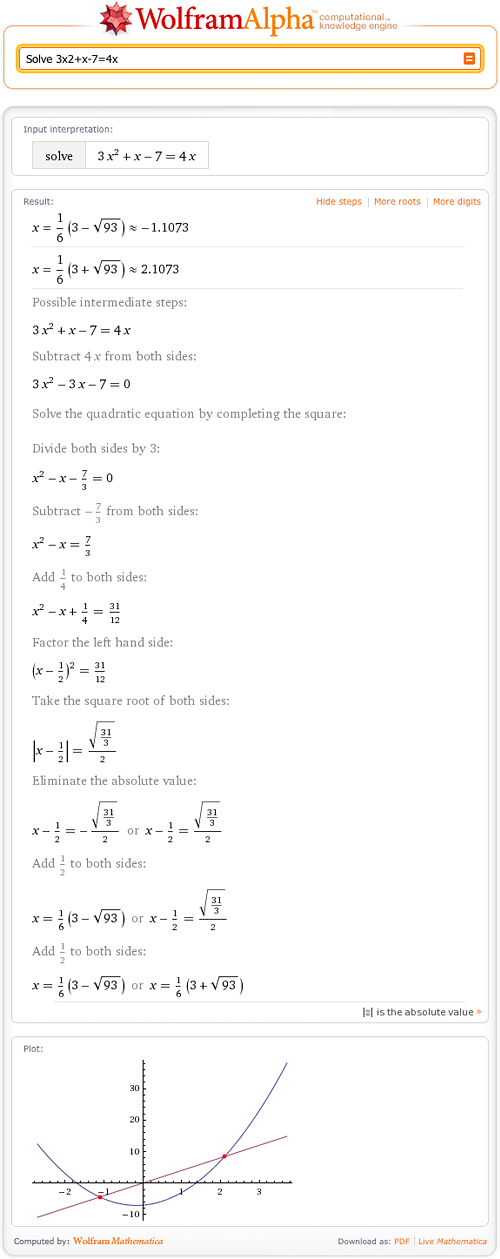



Several study techniques can help students learn mathematics more effectively.
Step-by-Step Problem Solving
Writing every step clearly helps avoid mistakes and makes it easier to review solutions.
Practice Different Types of Questions
Exposure to various problems helps students develop flexibility in applying concepts.
Review Concepts Regularly
Revisiting previously learned topics strengthens understanding and memory.
Teach Someone Else
Explaining a concept to another person helps reinforce your own understanding.
Common Difficulties in Learning Mathematics
Many students face challenges when learning mathematics.
Common difficulties include:
- Weak basic concepts
- Lack of regular practice
- Fear of making mistakes
- Memorizing formulas without understanding
Addressing these issues with proper study habits can significantly improve learning outcomes.
Benefits of Learning Mathematics
Strong mathematical skills provide many long-term benefits.
These include:
- Better logical reasoning
- Strong analytical thinking
- Improved academic performance
- Opportunities in scientific and technical careers
- Greater confidence in problem solving
Mathematics is not only a school subject but also a valuable life skill.
Conclusion
Learning mathematics becomes much easier when students focus on understanding concepts, practicing regularly, and developing logical thinking skills. By building strong foundations, studying step by step, and learning from mistakes, students can overcome difficulties and improve their mathematical abilities.
Using visual tools, asking questions, and applying effective study techniques further enhances understanding. With patience, consistent practice, and the right learning strategies, anyone can learn mathematics successfully and gain confidence in solving problems.